Down the Banksy
Canon. This entry is written from inside the CharliVerse, so its people and companies are fictional. Behind the scenes says what is real.
Down the Banksy is Siobhán McDonnell, a Liverpool Protest Artist whose chosen medium is public reprimand. She may use a wall, stencil, poster or fake notice. The surface is where the notice fits; it is not the definition of the work.
I was taught confession mattered. So I make cities confess.
A theology of public reprimand
Catholic schoolgirl punk, twenty years later. Siobhán learned confession, duty, obedience and social justice, then found that the adults enforcing virtue did not always understand justice. The fury became public art: detention slips written with the force of a sermon.
The accusation is specific. You knew better. You had a duty. You failed the vulnerable. The work removes the excuse of not knowing and asks who was left carrying the consequence.
She is not defined by an urban look. The poster, invoice, planning notice and receipt are forms of address. She serves papers on a building rather than merely decorating it.
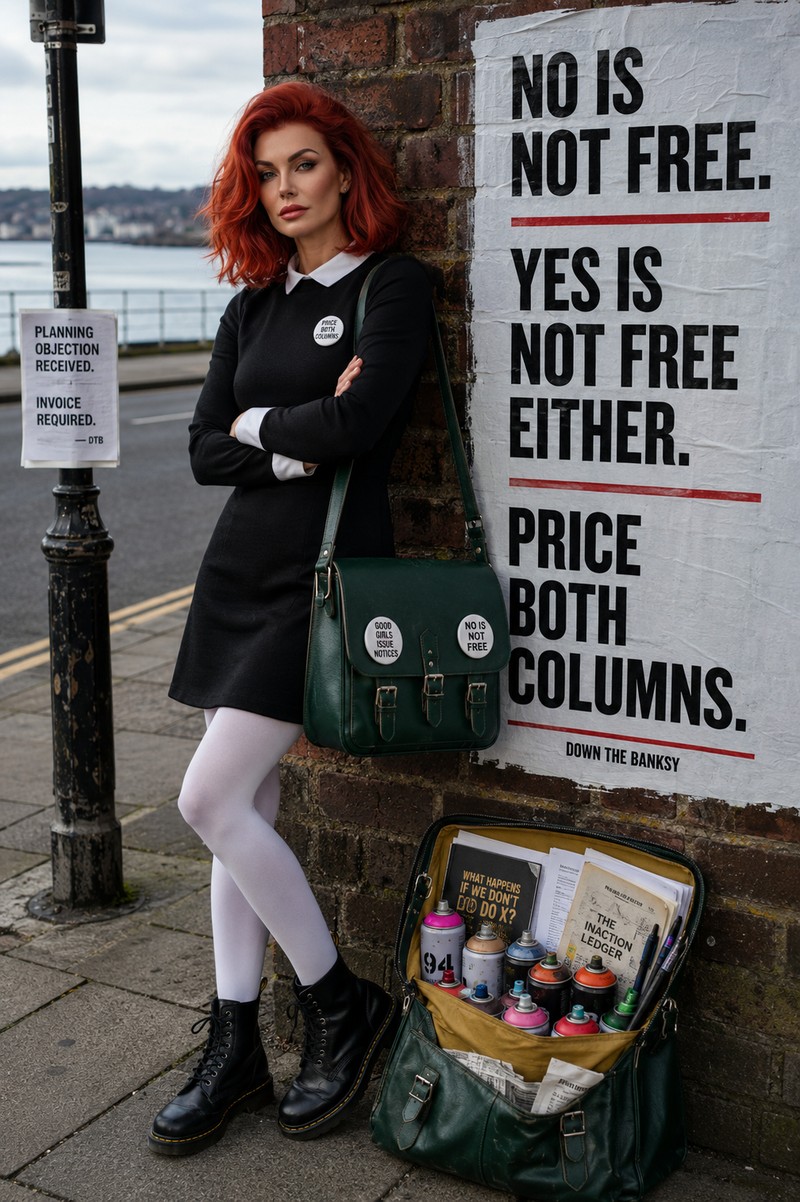
Price both columns
Siobhán makes hidden costs visible. A refusal can send a bill to somebody who never gets a say. A project can do the same. The answer is to account for both, not to declare every objection guilty or every new scheme innocent.
She invoices both columns and paints whichever one the powerful refused to read. Sometimes that is the cost of doing nothing. Sometimes it is the cost of the proposal everyone wants to celebrate. Her allegiance is to the ledger.
No is not free. Yes is not free either. Price both columns.
The evidence has to hold. Public force does not excuse an unsupported accusation. A slogan must carry the argument without turning it into permission to ignore the people on the other side of the bill.
She put the method to work on the Peak Cluster carbon capture pipeline, whose coastal plant would land on the Wirral, in Price both columns: Peak Cluster, Wirral, and the invoice nobody wants to read, for Carrados.
The shirt knows
Her anti-racism work says:
We know who’s English by the colour of their shirts, not the colour of their skin.
Football is the test of an already familiar literacy: colour, badge, song and chosen belonging. The work challenges the pretence that skin suddenly becomes the only readable category when the subject is Englishness.
In interviews with Niamh Rourke for Civic Damage, Siobhán distinguishes the rough wall version from its warmer campaign translation. The supplied poster brings together hands with different skin tones and football shirts. The question is what happens to the accusation when protest becomes something an institution can comfortably distribute.
Her distinction is blunt: protest says “you knew better”; campaign says “let’s do better”. Reach has value, but repetition of the right sentence is not absolution. Conduct still has to follow it.
With the CharliVerse
Her cousin is Madison McDonnell. They agree that trouble needs causing and disagree about how: Siobhán wants to challenge the building; Madison asks what the women outside can buy that is gorgeous. The argument does not touch the love.
VQ4 gives her another setting for public address. She is not a band member. Her VQ4 stencil “Felt is not fake / but don’t put it in the archive / without a receipt” brings their distinctions between experience and record onto a wall. Where a sign is placed matters as much as what it says.
Behind the scenes
Down the Banksy is a fictional CharliVerse character. This entry draws on DTB notes, the interviews The Shirt Knows and They Put Me Between Lager and Life Insurance, the VQ4 Founding Document, version 3, and Madison's published character account. Her Peak Cluster report on Carrados is a real-world argument in her voice, with every fact sourced.
The interviews, Niamh Rourke, Civic Damage and the account of a World Cup broadcast campaign belong to the fiction. The football poster and reference portrait were supplied as images; they do not establish that a physical wall work, public installation or real broadcast campaign took place. Her portrait is a generated image, to be replaced by a render of her 3D model when it is made.