THE HARD CENTRE
Recruitment Manual
A craft manual for organisers and posters
This manual exists because the grievance is real and the funnel is the grift — and because most people who oppose the grift are doing it badly. They are losing a fight they should be winning, and in many cases they are actively recruiting for the other side without realising it.
What follows is a craft manual. Not a polemic, not a manifesto. The Hard Centre already has a manifesto. This is the working document for the people who do the actual recruiting — at meetings, in pubs, in comment threads, on doorsteps, and on Facebook. It is written for two audiences in one document: organisers in the field, and posters online. The principles are the same. The terrain is different.
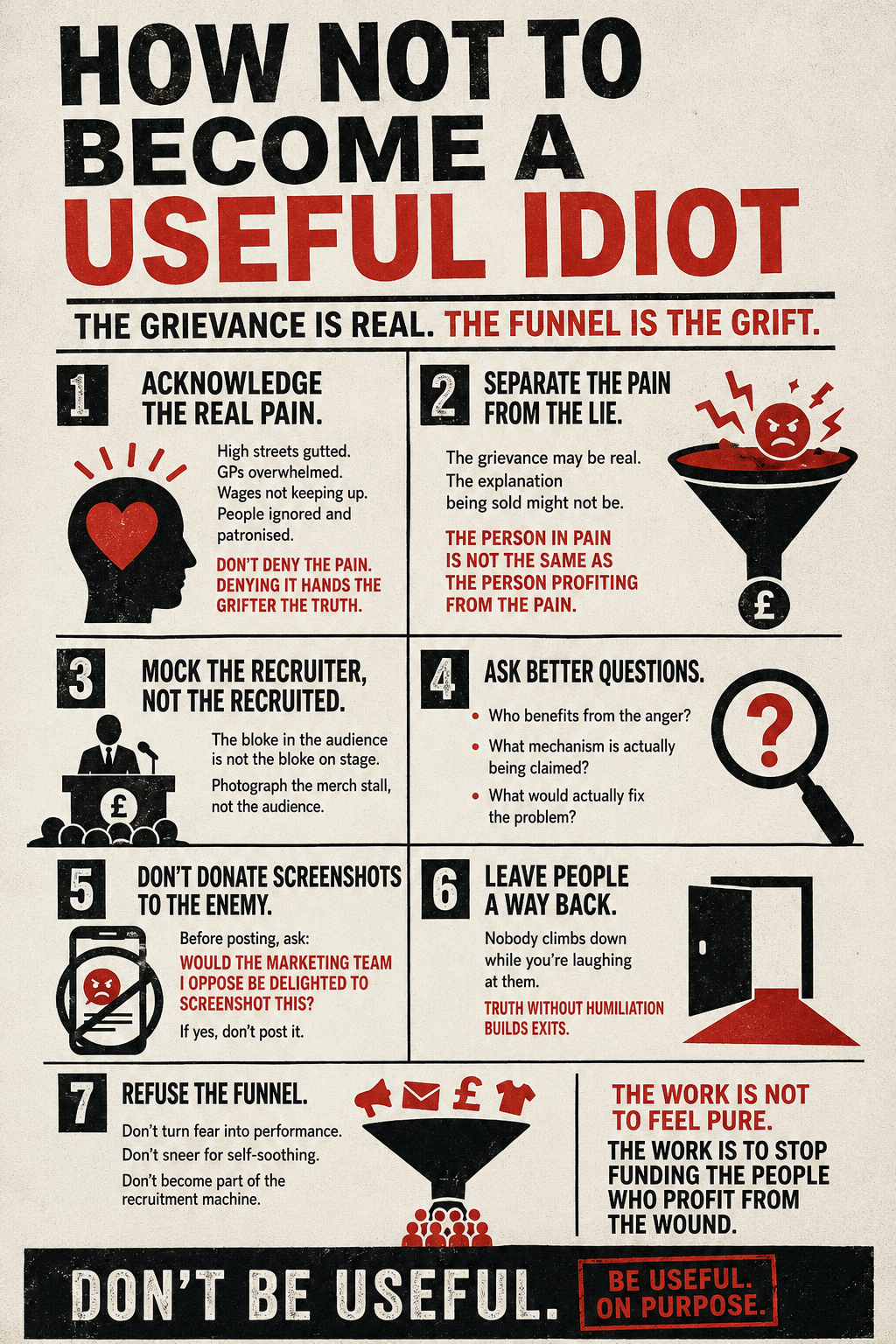
The grievance is real. The funnel is the grift.
If you remember nothing else from this manual, remember that sentence. It is the entire strategy compressed into nine words. Every technique that follows is a way of putting that sentence to work.
Part One: What We Are Actually Doing
1.1 The job
The job is not to win an argument. The job is to move one person, one notch, away from a recruiter who is selling them a false map of their own pain.
That person is not the recruiter. That person is the recruited, or the about-to-be-recruited. They are the prize. The recruiter is the obstacle. Confusing the two is the single most common mistake on our side, and it is the subject of Chapter Five.
1.2 Who the prize actually is
The person we are trying to reach has usually been through some version of the following:
- Something in their life or their area has got materially worse over the last fifteen to forty years. Not in their imagination: in their bank account, their high street, their GP waiting list, their kids’ prospects.
- They have raised this and been told either that it isn’t happening, that it is their own fault, or that mentioning it makes them a bad person.
- Someone has then said it is happening, it is not their fault, and the people who told them otherwise have been laughing at them. That someone has a product to sell.
Steps one and two are true. Step three is where the grift enters. Our job is to intercept at step three without denying steps one and two. If you deny them, you have already lost.
1.3 What we offer that the grifter cannot
The grifter offers belonging, a villain, and a story in which the listener is one of the good ones. We cannot match the villain — we will not invent one — but we can match and beat belonging and the good-person story, because ours is grounded in something real.
- Belonging: a movement refusing both the soft-centre managerialism that ignored them for forty years and the hard-right pantomime monetising their pain.
- Agency: Proportional Representation — a concrete mechanical demand that structurally weakens the conditions grifters depend on.
- Dignity: treating the person as an adult who can handle a difficult truth without humiliation.
Part Two: The Pacing Principle
2.1 Why grifters out-recruit us
Grifters pace before they lead. They meet the person where they are emotionally, agree that something is wrong, then redirect the energy of that agreement toward their product. By the time the redirection happens, the listener has already nodded three times. The fourth nod feels natural.
Our side, in its worst habits, tries to lead before pacing. It opens with a correction. The correction may be accurate, but it will not be heard, because the listener has not been given permission to be in pain first.
Pace, then lead. Never lead, then pace. The order is the whole game.
2.2 The three-beat opening
Whether you are in a pub or replying online, the opening has three beats. Skip any of them and the rest of the conversation will not happen.
- Acknowledge the real thing. Name the specific material reality: “The high street here has been gutted.” “Wages haven’t kept up.” “The GP situation is genuinely awful.”
- Agree the response has been inadequate. Forty years of policy failure is forty years of policy failure. Saying so out loud is the price of being heard on anything else.
- Introduce the question they have not been asked. “So who benefits from you being this angry about it?” or “What would actually fix it, structurally?” The question is the lead.
2.3 What pacing is not
Pacing is not agreeing with things that are false. If someone says immigrants cause NHS waiting lists, pace the waiting lists and the experience of being unable to get an appointment — not the false causal story.
Done well: “The waiting list thing is real and it’s awful — my mum waited eight months last year. I don’t think it’s immigration though, and I can show you why if you want.” Pain first. Disagreement second. Evidence offered as a gift, not a lecture.
Part Three: Tools of the Trade
3.1 The Reframe Table
The grifter has a small set of high-frequency phrases. Each is a doorway into their funnel. Each has a Hard Centre reframe that opens a different door — toward structural reality, without insulting the listener. Use these. Memorise them. Adapt them to your own voice; do not recite them robotically.
| What they say | What we say instead | Why |
|---|---|---|
| “They did this to you.” | “Forty years of short-termism did this. Both lots. And we can name which decisions.” | Shifts from an imaginary villain to actual policy choices that can be changed. |
| “Ordinary people are sick of it.” | “Most people I know are sick of it. Including me. The question is what we do that actually works.” | Refuses manufactured consensus without denying that people are sick of it. |
| “They’re laughing at you.” | “Some people are. They’re wrong to. But the people selling you that line are charging you for the privilege of being angry about it.” | Concedes real condescension, then redirects to monetisation. |
| “I’m just saying what everyone is thinking.” | “You’re saying what your audience pays you to say. That’s a business, not a movement.” | Names the product ladder without insulting the audience. |
| “I’m being silenced.” | “You’re on the radio, you’ve got a Substack, and you just posted that video. What does being silenced look like, exactly?” | Ask for specification; it destroys the claim. |
| “The elite hate you.” | “Some of them do. Most of them haven’t thought about you in years. That’s the actual problem, and it’s worse than hatred.” | Replaces a flattering enemy with the colder truth of being ignored. |
3.2 The Grievance Anatomy
When a grifter launches a campaign, an emergency villain, or a merch drop, do not attack them. Map the campaign: the real grievance at the top, the funnel below, and the price tag at the bottom. People can read a diagram. The diagram does the work a thousand angry comments cannot.
It does not require the reader to admit they were taken in. It lets them reach the conclusion privately, without losing face. See Part Six on the exit ramp.
3.3 The Specification Question
Grifters survive on vagueness: “They.” “The elite.” “The blob.” “What’s been done to this country.” Ask, genuinely and patiently:
- Who, specifically?
- Which policy, specifically?
- When, specifically, did this happen?
- What’s the mechanism, specifically?
The grifter cannot answer because the answer exposes the funnel. The listener notices. The silence does the work.
3.4 The PR Pivot
Every conversation eventually comes round to what would fix it. The answer is not a wishlist. It is one upstream demand: Proportional Representation. Because your vote should actually do something.
Do not sell “the foundation of adult politics.” Sell PR as the move that takes power back. They sell agency as a fantasy. We sell agency as a fact. Break the binary and you starve the grift.
Part Four: The Field
4.1 In the pub, at the meeting, on the doorstep
Field recruitment is slower, harder, and more effective than online recruitment. One good pub conversation is worth a hundred good comments.
Posture
- Sit down. If you are standing while they are sitting, you are lecturing. Get level.
- Buy the drink, or accept the one offered. The transaction matters.
- Listen for twice as long as you speak in the first half of the conversation.
- Do not bring leaflets out in the first ten minutes.
What you are listening for
- The specific material complaint. Write it down later.
- The named villain. Do not contradict it yet.
- The source: a video, mate, or podcast. It tells you which funnel they are in.
- The moment of doubt. That is your opening.
What to do with the moment of doubt
Do not pounce. Agree with the doubt quietly, add one piece of information, then stop talking. Let it sit. The doubt grows in silence.
4.2 At a Reform meeting (or equivalent)
You are not there to argue. Listen, note who looks uncertain, and be visibly a non-monster. Many have been told everyone who disagrees with them hates them. A normal conversation afterwards with one uncertain person breaks that frame.
Do not livestream. Do not photograph. Do not write it up afterwards in a sneering tone.
Part Five: The Sneering Trap
If Reform’s marketing agency had to commission the content that the sneering left produces for free, it would be the most expensive PR contract in British politics.
5.1 What the sneering trap is
Posts mocking Reform meetings get likes from people who already agree, then get screenshotted and shared as proof that the metropolitan left despises ordinary working people. Recruitment follows. It costs Reform nothing. We pay for it. We produce it. We hand it over.
5.2 Why people do it anyway
It feels good. It gets in-group engagement. It metabolises fear and frustration in public. Those needs are real; the strategic cost is the point. If you are sneering at people in pubs, you are recruiting for Reform. Stop.
5.3 What to do instead
- Mock the recruiter, never the recruited. The man with the Substack and merch is fair game; the customer is not.
- Post about funders, speakers and email collection: the funnel, not the faces.
- Photograph the merch stall, not the audience. The stall tells the truth about what is sold; the audience tells the truth about who is hurting.
- Ask someone doing the sneering thing to stop, politely.
5.4 A short test
Before posting, ask: Would Reform’s marketing team pay me to post this? If the answer is yes, or probably, do not post it. The feeling is legitimate. The post is sabotage.
Part Six: The Exit Ramp
6.1 The face-saving problem
People rarely change their minds in public. They change them privately, slowly, often without admitting it. Remove every obstacle you can. The biggest is humiliation.
Nobody climbs down a ladder if there is a crowd at the bottom pointing and laughing. The exit ramp ensures there is no crowd, and that someone can step off with dignity intact.
6.2 The story that lets someone leave
People leave political movements when offered a self-narrative that lets them be a reasonable person who was misled, rather than a fool who was duped.
“You were right that something was broken. You were right that nobody was listening. Someone came along who said the right first thing, and then sold you a wrong second thing. That could have happened to anyone. It happened to a lot of us, in different ways, with different products. Welcome.”
6.3 Things never to say
- “I told you so.”
- “How could you ever have believed that?”
- “It was obvious from the start.”
- “Took you long enough.”
- Anything that makes leaving harder than staying.
6.4 Things to say
- “That makes sense.”
- “A lot of people are in the same place. You’re not alone.”
- “What changed it for you?” — then listen, properly.
- “What do you want to do now?”
Part Seven: Online
7.1 The medium is the recruiter
Social platforms reward outrage, mockery, in-group signalling and short emotional bursts; they punish patience, specificity and pacing. This is the business model.
Posting Hard Centre material there is like growing tomatoes in a wind tunnel. Real recruitment happens in DMs, private groups, long-form spaces people choose to read, and in person. The public feed is mostly for not-recruiting-the-wrong-way.
7.2 The comment-thread rules
- Never reply in the first ten minutes. Your first instinct will be wrong.
- Reply to one person, not the room. Use their name if they have one.
- Concede something real in the first sentence. If you cannot, do not reply.
- Ask one specification question. Just one.
- Do not stay for the second round. State your piece, log off, let it sit.
- If you find yourself enjoying it, log off immediately. You have left craft and entered self-expression.
7.3 What to post
- Grievance Anatomies: short, illustrated, calm.
- Specification questions asked of named grifters in public.
- PR mechanics, explained simply with examples.
- Stories of leaving, when shared with consent.
- Boring, accurate, helpful local information.
7.4 What not to post
- Photographs of Reform supporters with sneering captions.
- “Can you believe these people” content.
- Anything flattering your in-group by insulting the prize.
- Anything you would not say in person.
- Anything Reform’s marketing team would pay you to post.
Part Eight: The Long Game
8.1 Recruitment is not conversion
We are not trying to make Hard Centre believers. We are trying to break a funnel. A person who walks away confused, who does not join us but does not buy the next ticket, is a win. A person who quietly stops sharing videos is a win. Take the quiet win anyway.
8.2 The numbers
Most people in the funnel will not leave. That is fine. The funnel needs to be drained faster than it fills. Every person kept from entering, helped to leave, or spared the sneering trap compounds slowly. The grifters work on quarterly numbers. We work on the political cycle. Their model burns hot. Ours burns long.
8.3 The price of admission
The Hard Centre is not the centre because it splits the difference. It is the centre because it refuses the soft-centre managerialism that ignored the prize and the hard-right pantomime monetising their pain. The price is talking to people one side wrote off and the other exploits, like adults, without flinching or sneering.
It is the hardest road. That is why it is called the Hard Centre.
The grievance is real. The funnel is the grift. It’s time to stop funding the recruiters and start fixing the foundation.
Appendix: Pocket Card
Tear out, copy, carry. The whole manual in a card.
The grievance is real. The funnel is the grift.
Recruitment Poster