The Shirt Knows
Down the Banksy interviewed by Niamh Rourke for Civic Damage
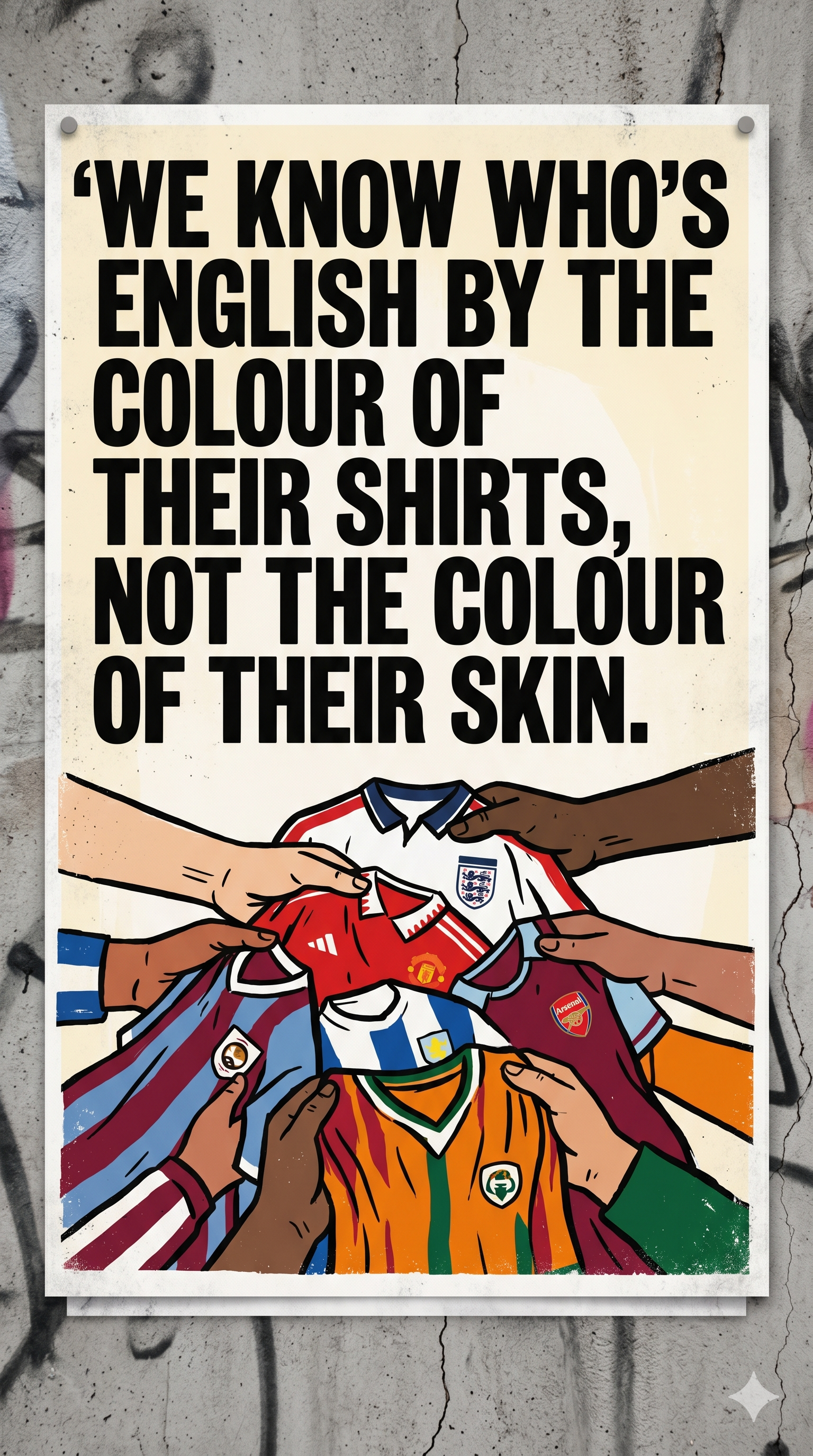
NIAMH ROURKE: Siobhán McDonnell, Down the Banksy, your new work says: “We know who’s English by the colour of their shirts, not the colour of their skin.” It has already travelled further than the wall it came from. What is it?
SIOBHÁN McDONNELL: It’s a detention slip for the nation.
NIAMH: That sounds like one of yours.
SIOBHÁN: Good. Because it is. It isn’t a celebration poster. It isn’t “football brings us together,” sponsored by a lager that tastes like a grievance with bubbles. It’s not bunting. It’s not a warm-up act for a bank advert. It’s a reprimand.
The sentence is simple because the lie it answers is simple. Football fans know identity is symbolic. They know colour. Badge. Shirt. Song. End. Stand. Family. Geography. Chosen loyalty. Inherited loyalty. They can identify a person’s football belonging from fifty yards by a strip of polyester. Then suddenly, when the subject is Englishness, some people pretend the only category they can read is skin. No. I don’t accept the temporary collapse in their literacy.
NIAMH: So the work is not patriotic?
SIOBHÁN: It is anti-racist. Those are not the same sentence. Patriotism always wants to adopt anti-racism once the poster looks clean enough. But the wall version was not saying “be proud of England.” It was saying: you already know this. Don’t stand there blinking like belonging is difficult. You have been reading shirts your whole life.
NIAMH: The campaign-style version has different hands, different skin tones, football shirts held together. It is warmer.
SIOBHÁN: Yes. It has been moisturised.
NIAMH: You don’t like it?
SIOBHÁN: I didn’t say that. That’s the annoying bit. The hands work. The image works. It will make some kid feel safer. It will make some racist uncle chew his own face for ten seconds before asking whether he’s “allowed to say anything anymore.” Both outcomes have value.
But the original was uglier because the original knew who it was talking to. Protest points. Campaign embraces. Sometimes you need embrace. Sometimes you need pointing.
NIAMH: Who is this pointing at?
SIOBHÁN: At the person who laughs along. At the person who says “leave it, it’s only football.” At the steward who hears it and looks away. At the broadcaster who loves the black player when he scores and reads the worst comments in silence when he misses. At the pub table where everyone suddenly gets fascinated by their crisps.
Racism does not survive on extremists alone. It survives on people who want the evening to stay comfortable.
NIAMH: That feels like the core of your work.
SIOBHÁN: My work is public moral address. People keep saying street artist, like I’m in love with brick. I’m not. Brick is where the notice fit. I don’t decorate surfaces. I issue notices. That has been the canon of Down the Banksy from the start: protest artist, not street artist; public reprimand, not urban style.
NIAMH: And this notice says?
SIOBHÁN: It says: you have run out of confusion. That’s what the best slogans do. They don’t explain the whole argument. They remove the last respectable hiding place.
NIAMH: You’ve said before that protest becoming campaign can lose the accusation.
SIOBHÁN: It can. Campaign says, “Let’s do better.” Protest says, “You knew better.” The first is useful. The second is necessary. The danger is when institutions take protest, file down its teeth, and call the smoothness “reach.” My previous interview already put that line down: protest points at someone; campaign points at everyone and says “let’s do better.”
NIAMH: So what is the accusation here?
SIOBHÁN: The accusation is that Englishness gets policed with fake innocence. “I’m just asking.” “Where are you really from?” “It’s not racist to notice.” “You can’t say anything now.” All that beige cowardice.
Football exposes the lie because football fans already accept invented belonging. They accept a person born nowhere near the ground becoming family because they wear the shirt, learn the song, suffer the losses, and keep coming back. They understand affiliation. They understand adopted identity. They understand chosen colour. Then some of them pretend nationhood must be blood chemistry. No, love. You’re not confused. You’re caught.
NIAMH: The image generated here is polished: poster, cracked concrete wall, bold black text, multiple hands, multiple shirts. The earlier imagined wall version was rougher — black paint, brick dust, a single defaced England shirt.
SIOBHÁN: That’s exactly the difference. The poster says, “This belongs in public.” The wall says, “This had to be said before anyone gave permission.”
NIAMH: Which one is true?
SIOBHÁN: Both. The wall is confession. The poster is distribution.
NIAMH: And what do you want people to do with it?
SIOBHÁN: Use it properly. Don’t just share it when an England player scores. Share it when he misses. Share it when the abuse starts. Share it when someone says “he’s not really one of us.” Share it when someone tries to make Englishness small enough to fit inside their own skin.
And then do the harder thing: say it at the table. Say it in the pub. Say it when there are no cameras. Say it when it ruins the mood.
NIAMH: Final line?
SIOBHÁN: The shirt was never the problem. The skin was never the problem. The problem was the person pretending they couldn’t tell the difference.