Come and Get Me
A cosy speculative accessibility story
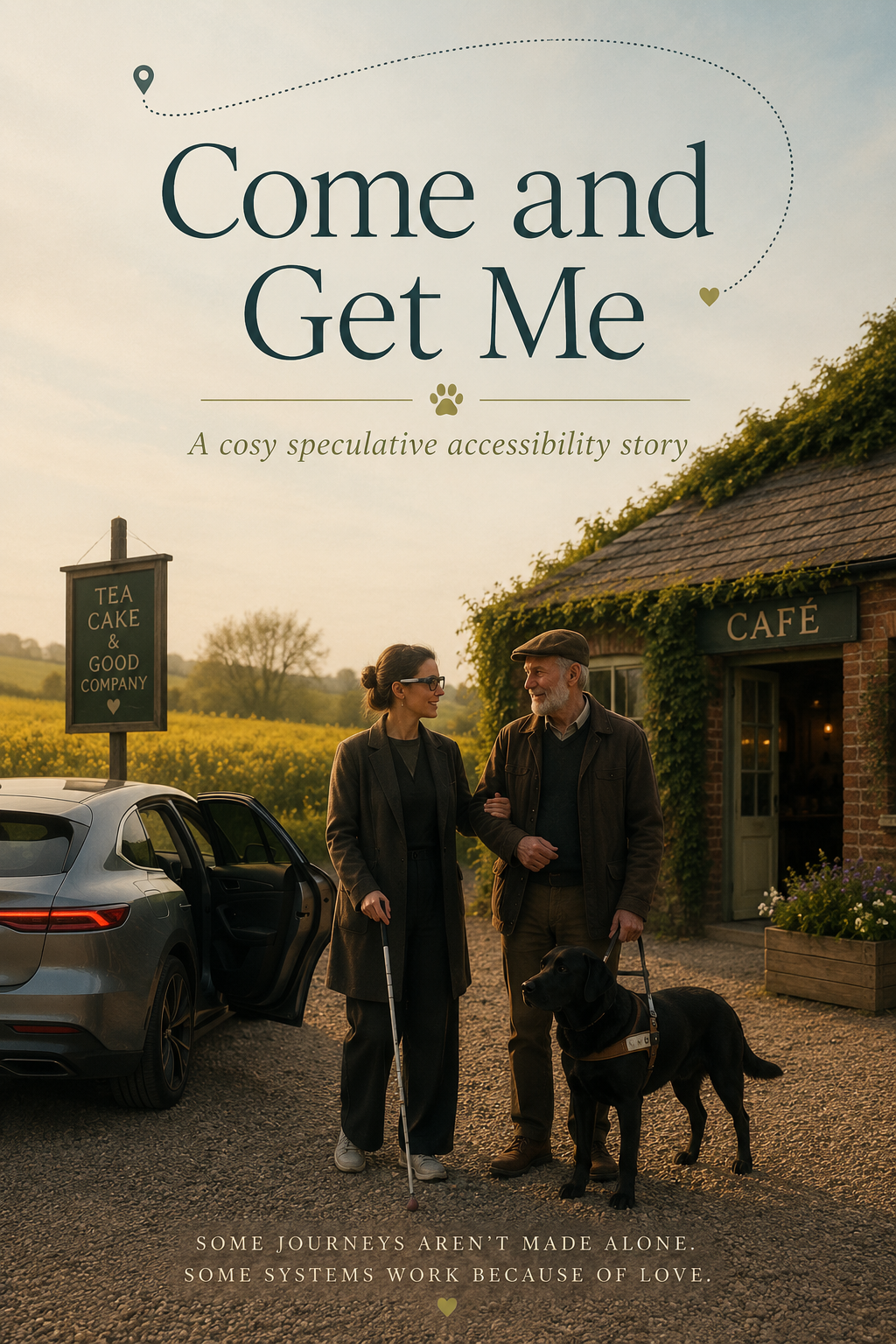
The car had been perfect.
It had collected her from her own kerb, pronounced her name correctly, and driven her forty-one miles without once asking her to confirm she was a human. Her agent had booked it, briefed it, and negotiated the drop-off while she listened to a novel. Somewhere around the bypass the glasses had mentioned, unprompted, that the rapeseed was in flower. She hadn’t asked. She’d liked it anyway.
She was, she felt, travelling like the future.
“You have arrived,” said the car, and opened the door onto the past.
The carpark had no metadata. It had no beacons, no broadcast, no semantic anything. It had gravel.
“Describe,” she said.
“You are facing a low brick building,” said the glasses, pleasantly. “There are seventeen cars, a wooden planter, and a sign.”
“What does the sign say?”
“The sign is angled away from you.”
Forty-one miles at motorway speed, flawless. Thirty metres of gravel: unsolved.
She stood in the exact centre of the gap between two civilisations and did what humanity has done at that location for ten thousand years.
She phoned him.
“I’m in the carpark,” she said. “Come and get me. Bring me into the café.”
“On our way,” he said, and she could hear the smile in his voice: warm, amused, faintly Radio 4.
*
He’d come by bus, of course. The 471, which he’d been catching for eleven years, and which knelt for the dog without being asked. He’d arrived twenty minutes early, because arriving early was a pleasure and not an inefficiency, and the girl behind the counter had said usual table? and the dog had taken him to it without ceremony.
He’d heard the car pull in. Electric. Expensive. The sound of someone arriving from miles away, alone, which he could not have done, and he knew it, and he’d decided in advance not to mind.
The dog found her immediately — she was the only person in the carpark standing perfectly still, narrating at her own glasses.
“They’re telling me about the planter,” she said. “In some detail.”
“It’s a nice planter,” he said. “Petunias.”
“They didn’t say petunias.”
“No,” he said. “They wouldn’t.”
She took his arm. The dog took the gravel, the kerb, the untagged step, the door that announced nothing, and the gap between the pushchair and the coat stand that no model anywhere had ever been trained on.
“Your guidance system smells of biscuits,” she said.
“He runs on them.”
*
They had tea for two hours. This was, by her usual accounting, an absurd allocation of time, and she billed none of it to anything.
He asked about the journey and meant it. She told him about the rapeseed. He told her the café had taken the braille menus away when they’d refurbished, and she said her glasses could read him the specials, and he said go on then, and they did, and he admitted it was good enough, and she admitted the dog was better at carparks, and neither of them surrendered anything that mattered.
At some point he said: “You really came all that way on your own?”
“Door to door,” she said. “Well. Door to gravel.”
He laughed. The dog sighed under the table, in the manner of one who has heard the gravel discourse before.
When they left, she ordered the car for an hour later than she needed to and didn’t examine why.
“Same time next week?” he said, at the door the building never announced.
“I’ll phone you from the carpark.”
“I know,” he said. “I’ll come and get you.”
It was, both of them privately concluded, an excellent system.
Zero information casualties reported.