The Tyrer Framework
Accessibility as Information Integrity
Author: Charli-Jo Tyrer
Date: 2026
Licence: CC BY-SA 4.0
Contents
- Abstract
- Introduction
- Part One: Tyrer’s Law
- Part Two: The Tyrer Accessibility Scale
- Part Three: Classical and Generative Accessibility
- Part Four: The Tyrer Doctrine
- Part Five: The AI Structural Break
- Part Six: The Tyrer Framework
Abstract
Technological civilisations can be characterised not only by their capacity to harness energy but also by their ability to distribute environmental information to all conscious agents within their domain. This paper presents the Tyrer Framework: an integrated theoretical structure comprising a diagnostic law, a civilisational scale, a design doctrine, and an analysis of the structural break introduced by artificial intelligence.
The framework rests on a central claim: inaccessibility is not primarily a failure of goodwill or compliance but a structural property of systems designed by agents whose dominant cognitive modality is vision. Left unchecked, this structural tendency produces information casualties — events in which relevant environmental information fails to reach an observer in time to inform perception, action, or participation.
The Tyrer Framework proposes that accessibility should be understood not as accommodation but as information integrity, and that the elimination of information casualties is a meaningful measure of civilisational advancement.
Introduction
For as long as digital systems have existed, blind and disabled users have lived with a persistent and frustrating pattern: tools that begin accessible gradually become unusable, even when no one intends that outcome. New features are added, interfaces grow richer, workflows become more visually intuitive, and accessibility quietly erodes.
This pattern is often discussed in moral or procedural terms. Developers forget accessibility. Teams deprioritise disabled users. Organisations fail to maintain standards. While all of these things occur, they do not fully explain the consistency or inevitability of the drift. The same pattern recurs across different teams, different organisations, different decades, and different technologies. Something structural is at work.
What is needed is an explanation that does not rely on bad faith — one that identifies the mechanism rather than assigning blame. The Tyrer Framework provides such an explanation. It begins with a diagnostic law that describes why accessibility erodes, extends into a civilisational scale that maps the trajectory from inaccessibility to perceptual sovereignty, defines a design doctrine that governs movement along that trajectory, and examines whether artificial intelligence introduces a genuine structural break in the pattern.
The framework draws on approximately four decades of lived experience as a blind user of access and assistive technology, and on the observation that the problems practitioners encounter today are not new failures but the same failure recurring under new names.
Part One: Tyrer’s Law
Statement of the Law
In open technological systems, inaccessibility tends to increase over time as interfaces drift toward the dominant sensory modality of their designers.
Tyrer’s Law is a claim about system behaviour, not about individual intent. It describes a tendency that operates at the level of architecture and accumulation rather than at the level of any single design decision.
The Mechanism
The mechanism behind Tyrer’s Law is straightforward. Most technology designers are sighted. For sighted people, visualisation is not merely a presentation choice; it is a thinking tool. Sighted designers reason spatially, manage complexity through layout, and experience visual representations as clarity itself. When a system grows in complexity, the instinctive response is visual: dashboards instead of logs, flowcharts instead of explanations, icons instead of labels, spatial arrangement instead of sequential structure.
This is not carelessness. It is cognition. Designers externalise their thinking in the modality that feels most natural to them, and for the overwhelming majority of designers, that modality is vision.
Open systems intensify this tendency. They are fast-moving, collaborative, and under constant pressure to demonstrate progress. Visual artefacts communicate progress quickly and persuasively. A screenshot of a new dashboard communicates more to a sighted stakeholder in two seconds than any amount of structured metadata. Accessibility, by contrast, requires constraint and deliberate maintenance. It is invisible when present and noticed only when absent.
The result is a ratchet. Each development cycle adds visual complexity. Each visual addition is a potential accessibility regression. Accessibility adaptations, where they exist, must keep pace with every new visual signal — but they are always reactive, always trailing, and always competing for resources against the next visible feature. Over time, the gap between visual complexity and accessible structure widens. The system drifts.
Information Casualties
Tyrer’s Law does not produce inconvenience. It produces information casualties.
An information casualty is an event in which relevant environmental information fails to reach an observer in time to inform perception, action, or participation. The term is deliberately chosen. When a blind pedestrian collides with an obstacle because no signal communicated its presence, the result is not a minor usability issue; it is a failure in the information layer of the environment. When a digital interface renders critical controls as unlabelled visual elements, the user who cannot perceive them has not been inconvenienced; they have been severed from the information they need to act.
Information casualties are not edge cases. They are the predictable output of systems operating under Tyrer’s Law. Wherever visual complexity accumulates faster than accessible structure, casualties follow.
Why the Pattern Persists
The persistence of the pattern is explained by an asymmetry in feedback. When accessibility degrades, the people most affected are often the least represented in the design process. Sighted developers do not experience the regression. Sighted testers do not detect it. Sighted stakeholders do not hear about it until a complaint arrives, by which point the visual complexity is entrenched and the cost of remediation is high.
Accessibility standards such as WCAG represent the most sustained and disciplined attempt to counteract this drift. They establish a deterministic floor: a set of requirements that, if met, prevent the most catastrophic information losses. Their achievement is substantial and their necessity is permanent. But they operate as a corrective force within a system whose default tendency is visual drift. They slow the law; they do not repeal it.
Part Two: The Tyrer Accessibility Scale
Purpose
If Tyrer’s Law describes why inaccessibility increases, the Tyrer Accessibility Scale describes where a civilisation stands in its capacity to prevent that increase — and where it could stand.
The scale classifies civilisations according to the proportion of environmental information that is accessible to all perceiving entities regardless of sensory modality. It is modelled on the structure of the Kardashev Scale, which classifies civilisations by their capacity to harness energy. The Tyrer Scale is complementary to Kardashev: a civilisation capable of harnessing stellar energy may still remain at the lowest level of the Tyrer Scale if its environmental information remains locked behind a single sensory channel.
Definitions
**Environmental information **is the total set of state variables describing the geometry, dynamics, and semantic context of a physical or social environment.
**A perceptual channel **is any biological or technological interface through which environmental information reaches a conscious observer.
**An information casualty **is an event in which relevant environmental information fails to reach an observer in time to inform perception, action, or participation. Examples include physical collisions caused by missing spatial information, inaccessible interfaces that block task completion, and cultural or social events whose meaning is restricted to a single sensory modality.
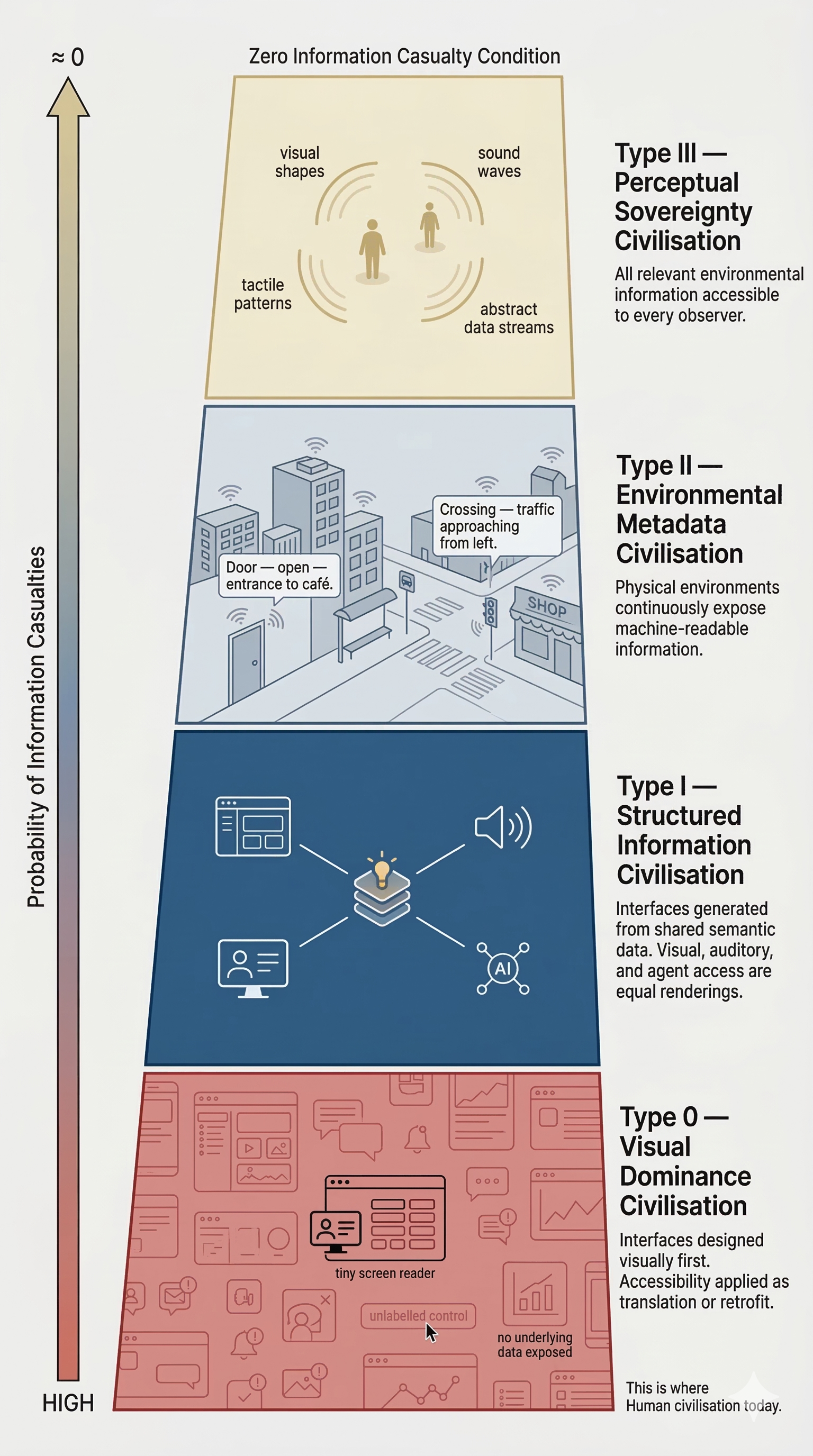
Type 0: Visual Dominance Civilisation
Environmental information is encoded primarily through visual signals. Accessibility exists as retrofitted assistance applied to artefacts designed for visual cognition. Information casualties are common and normalised.
In a Type 0 civilisation, interfaces are authored visually and then adapted, with varying degrees of success, for non-visual perception. The accessible version is always derived from the visual version. It is a translation, and like all translations, it loses information at every step. Screen readers interpret a visual layout that was never designed to be interpreted sequentially. Alternative text describes images that were never designed to carry their meaning in words. Keyboard navigation retraces paths that were designed for a pointer.
The most disciplined expression of Type 0 is full compliance with accessibility standards such as WCAG. This represents the best outcome available within the paradigm: the deterministic floor is intact, catastrophic information losses are prevented, and the system is usable. But the paradigm itself — visual artefact first, accessible adaptation second — remains unchanged. The floor holds, but the ceiling is fixed.
Human civilisation in the early twenty-first century is a Type 0 civilisation.
Type I: Structured Information Civilisation
In a Type I civilisation, information systems are designed with explicit semantic structure and multi-modal access from the outset. The accessible version of an interface is no longer derived from the visual version; both are generated from the same underlying data as equal, native expressions.
This represents a genuine paradigm shift. The interface ceases to be a fixed artefact authored in advance and becomes something produced at the moment of interaction, shaped by the context, constraints, and perceptual capabilities of the observer. For a sighted user, the system renders a visual dashboard. For a blind user, it renders a navigable summary or a structured data feed. For an AI agent, it renders function calls or structured queries. None of these is the original; none is the translation. Each is a first-class rendering of the same underlying reality.
Accessibility at this level becomes an engineering requirement rather than a social accommodation. The question is no longer whether the visual interface has been adapted for screen readers but whether the information layer exposes its state to any perceptual channel that requests it. Information casualties are significantly reduced in digital environments, though they persist in physical spaces that lack integrated information infrastructure.
The boundary between late Type 0 and early Type I is crossed when the accessible interface stops being a retrofit and starts being a native sibling generated from shared source data.
A note on register. Types 0 and I are engineering claims about the present: they describe conditions that either exist now or are achievable with current technology, and they can be tested against it. Types II and III are the philosophical extension of the scale. They describe where the trajectory points, not what is being proposed. The scale is offered in the same spirit as Kardashev’s: the near end is a measurement; the far end is a direction.
Type II: Environmental Metadata Civilisation
In a Type II civilisation, the physical environment itself becomes an information network. Objects, structures, and public spaces continuously broadcast machine-readable descriptions of their geometry, state, and purpose. Environmental information is dynamically available to any observer through any perceptual channel.
The experience of moving through a Type II environment as a blind person is qualitatively different from anything available today. A door does not need to be found by touch or memory; it announces its position, its state, and its purpose. A shop does not need to be identified by signage; it declares its contents, its layout, and its current activity. A street does not need to be navigated by counting steps or listening for traffic patterns; it communicates its geometry, its hazards, and its flow in whatever modality the observer can receive.
Mute objects cease to exist. Every physical entity in the built environment carries metadata that can be rendered into any perceptual channel. Information casualties become rare and are treated as infrastructure failures rather than personal misfortunes.
The boundary between Type I and Type II is crossed when the principles of structured information access extend from digital systems into the physical environment.
Type III: Perceptual Sovereignty Civilisation
In a Type III civilisation, all environmental information relevant to perception and participation is accessible to every conscious observer regardless of biological sensory capability. The distinction between description and direct perception collapses. Information is not encoded in a single modality and then translated; it is rendered dynamically across perceptual systems at the point of consciousness.
A Type III civilisation has achieved what might be called perceptual sovereignty: the guarantee that no observer’s access to reality is mediated by the accident of which sensory channels they possess. Environmental information cannot become trapped behind vision, hearing, or any other single modality. The concept of a sensory disability, in its current meaning, has no referent; it describes a limitation that the civilisation’s infrastructure has rendered inoperative.
This is the theoretical endpoint of the scale. Its defining condition can be stated formally: for all observers within the civilisation’s domain, the probability that relevant environmental information fails to reach consciousness approaches zero. Operationally, this is the Zero Information Casualty condition.
Relationship to Energy-Based Scales
The Tyrer Accessibility Scale is independent of, and complementary to, the Kardashev Scale. Kardashev measures a civilisation’s capacity to control energy. The Tyrer Scale measures its capacity to distribute information across perceptual channels. These are orthogonal dimensions of civilisational development. A society that can harness the energy output of its star but cannot ensure that a blind citizen can safely cross a street has mastered one dimension and failed at the other.
Progress along the Tyrer Scale does not require exotic energy sources or speculative physics. It requires engineering discipline, information architecture, and the political will to treat perceptual access as infrastructure rather than charity. The transition from Type 0 to Type I is achievable with current technology. The question is not capability but priority.
Part Three: Classical and Generative Accessibility
The Paradigm Shift
The transition from Type 0 to Type I on the Tyrer Scale corresponds to a paradigm shift in how accessibility is understood and practised. This shift can be described as the move from classical accessibility to generative accessibility.
Classical accessibility operates on fixed artefacts. A web page is authored, a layout is designed, a control is placed, and then the artefact is made accessible through semantic markup, alternative text, keyboard handlers, and compliance with established standards. The process is deterministic: the artefact exists in a known state, and the accessibility layer describes or adapts that state for non-visual perception.
This model has carried real weight for more than three decades. Screen readers, WCAG, ARIA, semantic HTML, keyboard navigation — these represent an extraordinary collective achievement. They are the deterministic floor that prevents catastrophic information loss in digital environments. Their necessity is permanent.
But the web these tools were designed for was a web of fixed objects located at static coordinates that looked the same to everyone. Accessibility was the act of retrofitting those fixed objects for different perceptual tools. That web is disappearing. Interfaces are increasingly generated at the moment of interaction, shaped by data, context, and inference. The artefact that the classical model was designed to make accessible no longer exists as a stable entity by the time the user arrives.
The Quantum Web
The shift can be understood through an analogy. The web that classical accessibility was designed for was Newtonian: a world of fixed objects at known positions obeying predictable rules. The web that is emerging is quantum: the interface exists in a state of superposition until an observer arrives, at which point it collapses into a specific rendering shaped by context and capability.
In a generated world, the interface a sighted user sees is one collapse of the underlying data. The interface a blind user receives is another collapse of the same data. The interface an AI agent consumes is a third. None is the original and none is the adaptation. Each is an equally valid rendering of the same information state.
This is the structural definition of Type I: the accessible interface is not a translation of the visual version. It is a native sibling, generated from shared source data.
The Convergence of Agents and Accessibility
This paradigm shift is accelerated by an unexpected convergence. AI agents and assistive technologies now require the same thing from information systems: explicit intent, deterministic state, clear hierarchy, and the absence of visual noise.
For decades, the accessibility community asked developers to expose semantic structure for screen readers. The request was understood as a niche accommodation. Now, the entire technology industry is restructuring its interfaces to expose semantic structure for AI agents. The infrastructure that agents require is, in its essentials, the infrastructure that blind users have always needed. Accessibility is no longer a sidecar; it is the human-facing expression of the agent interface.
This convergence is the most strategically significant development in the history of digital accessibility. For the first time, the economic incentives of the mainstream technology industry are aligned with the structural requirements of accessible design. The question is whether the accessibility community recognises and acts on this alignment before it passes.
The Dangers of the Transition
If the shift to generative accessibility sounds promising, it should also sound dangerous. Three failure modes require particular attention.
**The first is fragmentation. **In a world of generated interfaces, users may inhabit different versions of the same system. If the interface collapses differently for every user based on inferred intent, shared reference disappears. Troubleshooting becomes impossible when two users cannot confirm they are looking at the same thing. Collaboration fractures when the generated reality diverges. For disabled users, the risk is isolation: a *simplified *version of the interface that removes complexity under the guise of helpfulness, trapping the user in a reduced reality they cannot see past.
**The second is silent failure. **Classical accessibility fails loudly. An unlabelled button is detectable. A missing heading is auditable. Generative accessibility can fail silently. If the system infers that a user is confused and collapses their interface into a simplified mode, the user may never know what they have lost. This is not a bug; it is invisible, systemic discrimination operating at the level of inference rather than design.
**The third is the verification burden. **If the interface is generated rather than fixed, how does the user know it is accurate? A sighted user may trust a generated chart because it looks right. A blind user receiving a generated summary must wonder whether the summary reflects the data or the system’s assumptions about what the user wants to hear. This imposes a cognitive tax of constant verification that falls disproportionately on users who are already working harder to access the information.
Governance and the Right to Inspect
When accessibility moves from fixed artefacts to generated systems, the discipline shifts from compliance to governance. It is not possible to audit an interface that does not exist until it is generated and disappears when the user leaves. What can be governed is the system that generates it.
The foundational governance principle for generative accessibility is the Right to Inspect. No user should be required to accept a generated interpretation they cannot interrogate. If the system produces a summary, the user must have the ability to request the underlying data. If the system renders a simplified view, the user must have the ability to request the full complexity. If the system collapses the interface into one modality, the user must have the ability to demand an alternative collapse.
This principle is not specific to disabled users. In an AI-mediated world, the tools required for accessibility — the ability to inspect the source, to verify the state, to control the rendering — become the fundamental safeguards for everyone. Accessibility governance becomes information governance. The sidecar becomes the chassis.
Part Four: The Tyrer Doctrine
Statement of the Doctrine
Systems should be engineered so that no critical environmental information is accessible through only a single sensory channel.
The Tyrer Doctrine is a design principle for technological systems operating in high-information environments. It is the prescriptive response to the diagnostic problem identified by Tyrer’s Law and the trajectory described by the Tyrer Accessibility Scale.
Principles
**First: accessibility is information integrity, not accommodation. **When a system renders critical information through only one sensory channel, the problem is not that some users have been insufficiently accommodated; the problem is that the system has a single point of failure in its information layer. Redundancy across perceptual channels is an engineering requirement for the same reason that redundancy across servers is an engineering requirement: single points of failure produce casualties.
**Second: missing signals are system failures, not user limitations. **When an observer fails to receive environmental information, the Doctrine locates the failure in the system, not in the observer. A blind person who walks into an obstacle has not failed to see it; the environment has failed to communicate it. A screen reader user who cannot operate a control has not failed to perceive the interface; the interface has failed to expose its state. This reframing is not semantic; it determines where resources are directed and where accountability falls.
**Third: the deterministic floor is permanent; the generative ceiling is the frontier. **Classical accessibility standards represent the deterministic floor: the set of requirements that, if met, prevent catastrophic information loss. This floor is not optional, not transitional, and not replaced by generative systems. It is the safety rail that prevents the system from collapsing into chaos. Above the floor, generative accessibility extends the ceiling: adaptive, context-sensitive rendering that meets the observer’s perceptual capabilities and intent. The floor holds the line. The ceiling raises it.
Application
The Doctrine applies at every level of system design, from individual interface components to urban infrastructure. At the interface level, it requires that every control, every status indicator, and every piece of content be reachable through at least two independent perceptual channels. At the system level, it requires that information architecture expose semantic structure as a first-class property rather than a secondary annotation. At the environmental level, it requires that the built world communicate its state through channels that do not depend on any single sensory modality.
The Doctrine does not specify how these requirements are met. It does not mandate particular technologies, standards, or implementation patterns. It states the condition that must be satisfied and leaves the engineering to the engineers. Its purpose is to establish the principle that information locked behind a single sense is information at risk.
Part Five: The AI Structural Break
Why AI Is Different
Tyrer’s Law describes a pattern that has held for the entire history of digital technology. Systems drift toward visual cognition because their designers think visually, and the drift compounds over time because visual complexity accumulates faster than accessible structure. No previous technology has disrupted this pattern. Assistive technologies have mitigated its effects; accessibility standards have slowed its pace; but the underlying tendency has remained intact.
Artificial intelligence introduces a genuine structural break. For the first time, a widely deployed technology exists that can mediate between information and perception without requiring the information to be externalised visually first.
From Interface-First to Intent-First
Traditional information systems follow an interface-first model. The system presents a visual interface; the user learns to operate it; assistive technology translates the visual presentation into an alternative modality. The information must pass through a visual encoding before it can be decoded into anything else.
AI-mediated systems can follow an intent-first model. The user states what they want to accomplish; the system reasons about how to accomplish it; the result is delivered in whatever modality the user can receive. The information never needs to be visually encoded at all. The visual interface, where it exists, is one possible rendering among many rather than the canonical source from which all other renderings are derived.
This is the mechanism by which AI can weaken Tyrer’s Law. If cognition can be internalised within the system and meaning can be exposed semantically rather than visually, the gravitational pull toward visual encoding is reduced. The system no longer needs to externalise its state as a visual artefact in order for a human to interact with it. The default modality shifts from visual presentation to semantic exchange.
The Fork
The structural break is real, but its direction is not guaranteed. AI can follow two paths.
On the first path, AI amplifies visual complexity. Interfaces become more visually sophisticated, more dynamically generated, more personalised in their visual presentation — and the gap between visual richness and accessible structure widens faster than ever. Tyrer’s Law accelerates rather than weakens. AI becomes the most powerful engine of visual drift yet produced.
On the second path, AI acts as a cognitive intermediary. It sits between information and perception, rendering meaning into whatever channel the observer requires. The interface becomes a negotiation between the system’s information state and the user’s perceptual capabilities, mediated by an intelligence that can bridge the gap without requiring a visual detour. Tyrer’s Law weakens because the mechanism that drives it — the compulsory visual encoding of information — is no longer compulsory.
Only the second path leads toward Type I on the Tyrer Scale. The first path entrenches Type 0. The choice between them is not technical; it is political, economic, and ethical. It will be determined by what systems are built, what standards are adopted, what incentives are created, and whose voices are heard in the process.
Part Six: The Tyrer Framework
Synthesis
The Tyrer Framework is the integrated structure formed by the four components described in this paper. Each component performs a distinct function, and together they constitute a complete account of why accessibility degrades, where a civilisation stands in its capacity to prevent that degradation, what design principle should govern the response, and what structural opportunity the current moment presents.
**Tyrer’s Law **provides the diagnosis. It explains why inaccessibility is not a series of isolated failures but a structural tendency inherent in systems designed by visually dominant agents. The law is descriptive, not prescriptive; it identifies the mechanism without proposing a solution.
**The Tyrer Accessibility Scale **provides the map. It describes the trajectory from visual dominance to perceptual sovereignty, defining four stages of civilisational development measured by the proportion of environmental information accessible to all observers. The scale is diagnostic: it allows a civilisation to locate itself and identify what the next transition requires.
**Classical and generative accessibility **describes the paradigm shift that marks the transition from Type 0 to Type I. Classical accessibility is the deterministic floor; generative accessibility is the adaptive ceiling. The transition is marked by a specific structural change: the accessible interface ceases to be a translation of the visual version and becomes a native rendering of shared source data.
**The Tyrer Doctrine **provides the design principle. It states the condition that all systems should satisfy: no critical environmental information accessible through only a single sensory channel. The Doctrine is the prescriptive bridge between the diagnosis and the trajectory, translating the structural problem identified by the Law into an engineering requirement that drives movement along the Scale.
**The AI structural break **provides the context for the current moment. It identifies why, for the first time in the history of digital technology, a widely deployed technology exists that could weaken the mechanism described by the Law. It also identifies the fork: AI will either accelerate visual drift or enable semantic access, and the outcome depends on choices being made now.
The Central Claim
The Tyrer Framework advances a single central claim: accessibility is not accommodation; it is information integrity.
When a system fails to deliver environmental information to an observer, the failure belongs to the system. When a civilisation tolerates widespread information casualties, the deficit belongs to the civilisation. When a technology emerges that could reduce information casualties toward zero but is instead deployed to amplify visual complexity, the responsibility belongs to those who chose that path.
The framework does not ask for compassion, flexibility, or special treatment. It asks for information integrity: the same engineering principle that governs every other critical system in which the failure to deliver the right information to the right observer at the right time is treated as an unacceptable fault.
Implications
If the framework is correct, several consequences follow.
First, accessibility engineering is not a specialised subdiscipline but a core activity in the maintenance of information infrastructure. Organisations that treat it as an afterthought are operating with a known single point of failure in their information layer.
Second, progress along the Tyrer Scale becomes a meaningful metric of civilisational development. A society’s accessibility maturity measures something real: the extent to which its information environment serves all of its members rather than only those who happen to share the dominant sensory modality of its designers.
Third, the current moment is not ordinary. The convergence of AI capabilities, agent infrastructure, and generative interface design creates a window in which the structural conditions of the Tyrer Scale’s Type I transition are achievable with existing technology. Whether that window is used or wasted depends on decisions being made now, in standards bodies, in engineering teams, in policy discussions, and in the accessibility community itself.
Fourth, the economic case for accessibility is transformed. Information casualties are not merely social harms; they are system failures with measurable costs. Lost productivity, excluded users, inaccessible services, and the remediation burden of retrofitting visual systems all represent the cost of operating at Type 0 when the technology to move beyond it exists.
Conclusion
The Tyrer Framework is an argument for taking accessibility seriously as engineering, as infrastructure, and as a measure of what a civilisation values.
It begins with a structural observation: systems drift toward vision because their creators think visually, and the drift produces casualties. It extends that observation into a civilisational trajectory: from visual dominance, through structured information, through environmental metadata, to perceptual sovereignty. It proposes a design principle: no critical information locked behind a single sense. And it identifies the current moment as a genuine inflection point: the first time in the history of technology that the structural conditions exist to weaken the drift rather than merely slow it.
The endpoint is not utopian. It is an engineering target: zero information casualties. Every system that fails to deliver environmental information to an observer is a system with a fault. Every civilisation that normalises those faults is a civilisation that has chosen to leave the problem unsolved.
The tools to solve it are arriving. The question is whether they will be used.
This Document in Other Renderings
This page is the canonical publication of the Tyrer Framework. The same document is also available as a Word file: Download the Tyrer Framework as a Word document (.docx). Read the plain-language rendering: Why Accessibility Keeps Getting Worse — and Why, for the First Time, It Might Not. The HTML at this URL is the authoritative version; the Word file is a rendering of it.